
For three hours last summer, Wilfredo José Burgos-Matos felt like he didn't have to leave Puerto Rico again after moving away from the island 11 years ago.
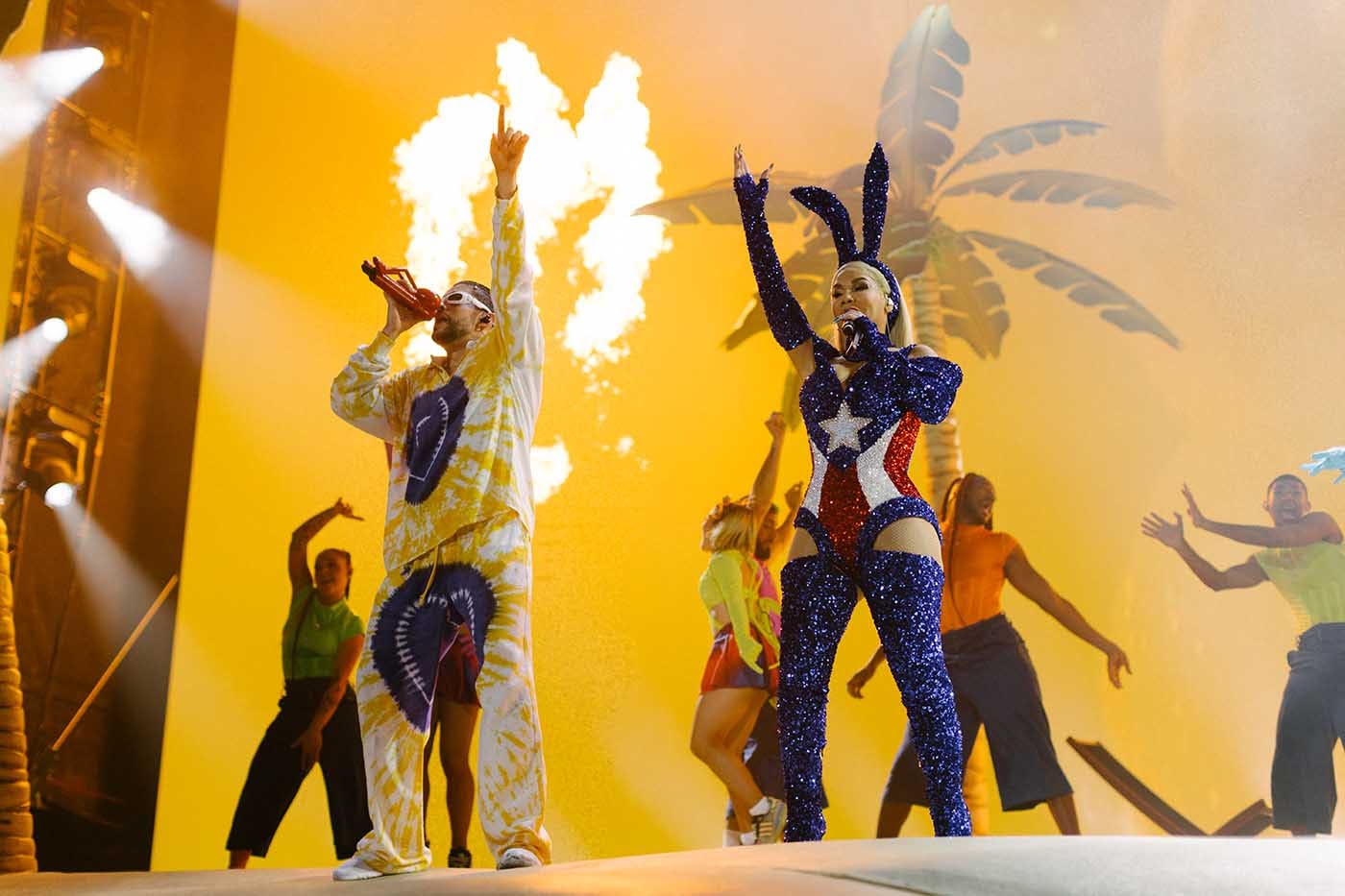
Bad Bunny's residencyin San Juan last August hit Burgos-Matos like a wave of nostalgia, from the plena-style rhythm mixed with reggaeton and salsa filling "El Choli" coliseum to the pink casita and mountains built for the stage, bringing him back to his hometown of Aibonito, Puerto Rico.
"It just very honestly made me kind of realize, or even dream a little bit, about staying and not having to live again and go through this diaspora mourning, or this grief of always being in constant movement outside of the island," the 33-year-old said. "It's some sort of a gift that that Bad Bunny gave to Puerto Ricans."
Now,Bad Bunnyis bringing that same energy to one of the biggest global stages this weekend: theApple Music Super Bowl LX Halftime Show. Bad Bunny has repeatedly centered Puerto Rico in his music and his career, including his latest album, "Debí Tirar Más Fotos," and his recent 31-date"No Me Quiero Ir de Aquí" residencyin San Juan that generated millions into the island's local economy.
 Bad Bunny accepts the album of the year award for "DeBÍ TiRAR MáS FOToS" onstage during the 68th Grammy Awards on Feb. 1, 2026, in Los Angeles" style="max-width:100%; height:auto; border-radius:6px; margin:10px 0;" loading="lazy" />
  Bad Bunny poses with the album of the year, best música urbana album and best global music performance awards during the 68th Grammy Awards." style="max-width:100%; height:auto; border-radius:6px; margin:10px 0;" loading="lazy" />


 Puerto Rican singer Bad Bunny performs onstage during the first show of his 30-date (which ended up being 31 in total) concert residency at the Coliseo de Puerto Rico in San Juan, Puerto Rico, on July 11, 2025. " style="max-width:100%; height:auto; border-radius:6px; margin:10px 0;" loading="lazy" />
  Bad Bunny thanked his fans for "letting me sing in my home in front of my friends, my family and my people" on what was the final night of his residency in September 2025. "Thank you for that," he said. "I love you, thank you for being a part of this."" style="max-width:100%; height:auto; border-radius:6px; margin:10px 0;" loading="lazy" />
  On top of his Puerto Rico residency, Bad Bunny was also juggling life as a Hollywood actor attending the premiere of "Caught Stealing" on Aug. 26, 2025, in New York City. " style="max-width:100%; height:auto; border-radius:6px; margin:10px 0;" loading="lazy" />
  Bad Bunny starred alongside Austin Butler in the movie. " style="max-width:100%; height:auto; border-radius:6px; margin:10px 0;" loading="lazy" />
  Earlier in summer 2025, Bad Bunny was spotted at Netflix's "Happy Gilmore 2" premiere on July 21, 2025, in New York City, which he starred alongside Adam Sandler." style="max-width:100%; height:auto; border-radius:6px; margin:10px 0;" loading="lazy" />
  Bad Bunny at the 2025 Met Gala Celebrating "Superfine: Tailoring Black Style" at Metropolitan Museum of Art on May 5, 2025. Bad Bunny gave a playful Puerto Rican twist to the Black dandy theme with a crisp espresso brown suit. He paired the custom-made Prada ensemble with a brimmed hat resembling a pava, a traditional straw hat made from leaves of the Puerto Rican hat palm." style="max-width:100%; height:auto; border-radius:6px; margin:10px 0;" loading="lazy" />
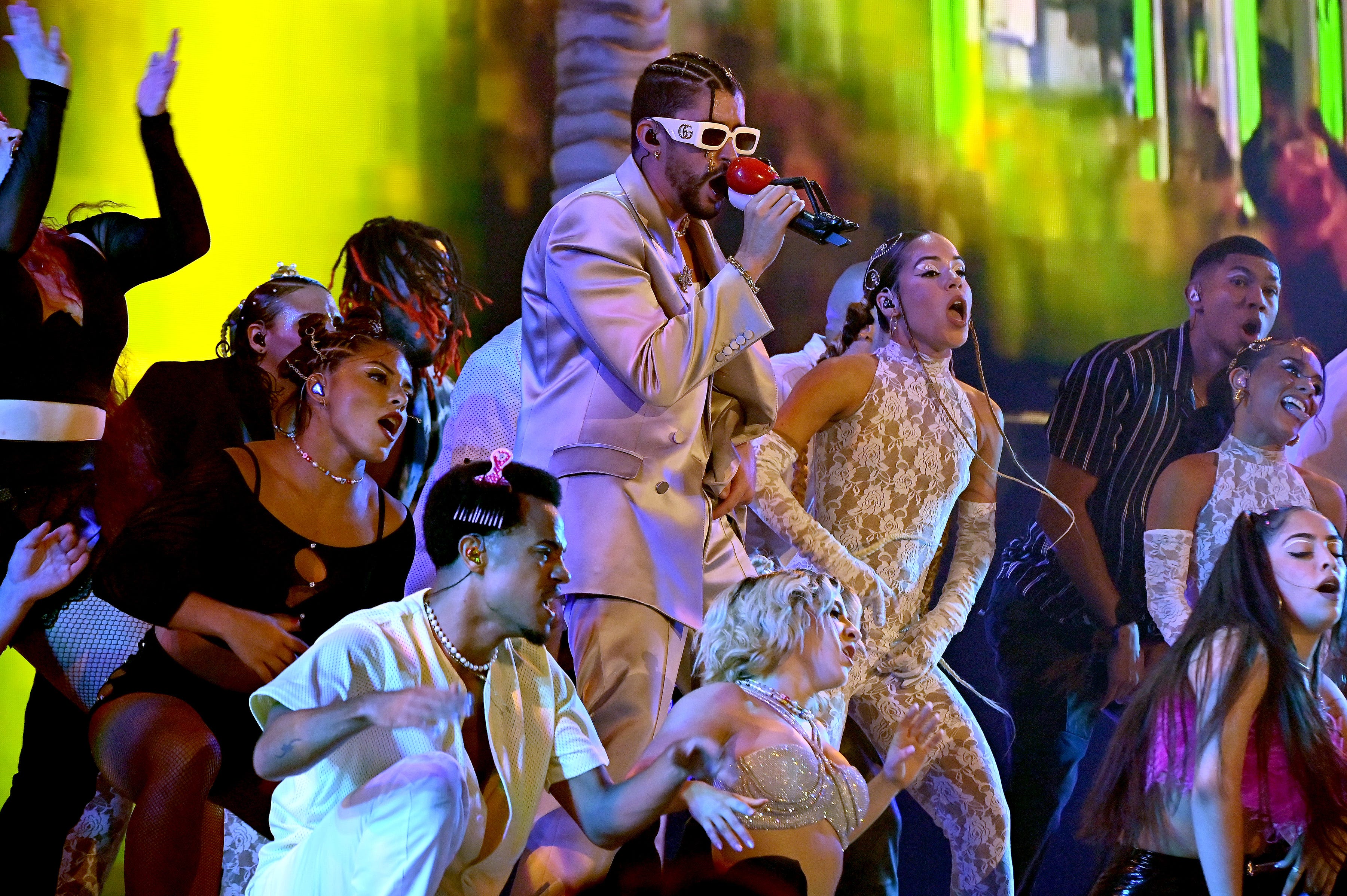
  Bad Bunny onstage at the 2025 iHeartRadio Music Awards at Dolby Theatre in Los Angeles on March 17, 2025. " style="max-width:100%; height:auto; border-radius:6px; margin:10px 0;" loading="lazy" />
  Bad Bunny onstage at the 2025 iHeartRadio Music Awards at Dolby Theatre in Los Angeles on March 17, 2025. " style="max-width:100%; height:auto; border-radius:6px; margin:10px 0;" loading="lazy" />
  Bad Bunny onstage at the 2025 iHeartRadio Music Awards at Dolby Theatre in Los Angeles on March 17, 2025. " style="max-width:100%; height:auto; border-radius:6px; margin:10px 0;" loading="lazy" />
  In February 2025, Bad Bunny attended "SNL50: The Anniversary Special" in New York City. " style="max-width:100%; height:auto; border-radius:6px; margin:10px 0;" loading="lazy" />
  Bad Bunny performs during his Most Wanted Tour at the Kaseya Center in Miami on May 24, 2024. " style="max-width:100%; height:auto; border-radius:6px; margin:10px 0;" loading="lazy" />
  Bad Bunny attends the Dior Homme Menswear spring/summer 2025 show as part of Paris Fashion Week on June 21, 2024. " style="max-width:100%; height:auto; border-radius:6px; margin:10px 0;" loading="lazy" />
  Bad Bunny performs at the Crypto.com Arena during his Most Wanted tour in Los Angeles, March 13, 2024." style="max-width:100%; height:auto; border-radius:6px; margin:10px 0;" loading="lazy" />


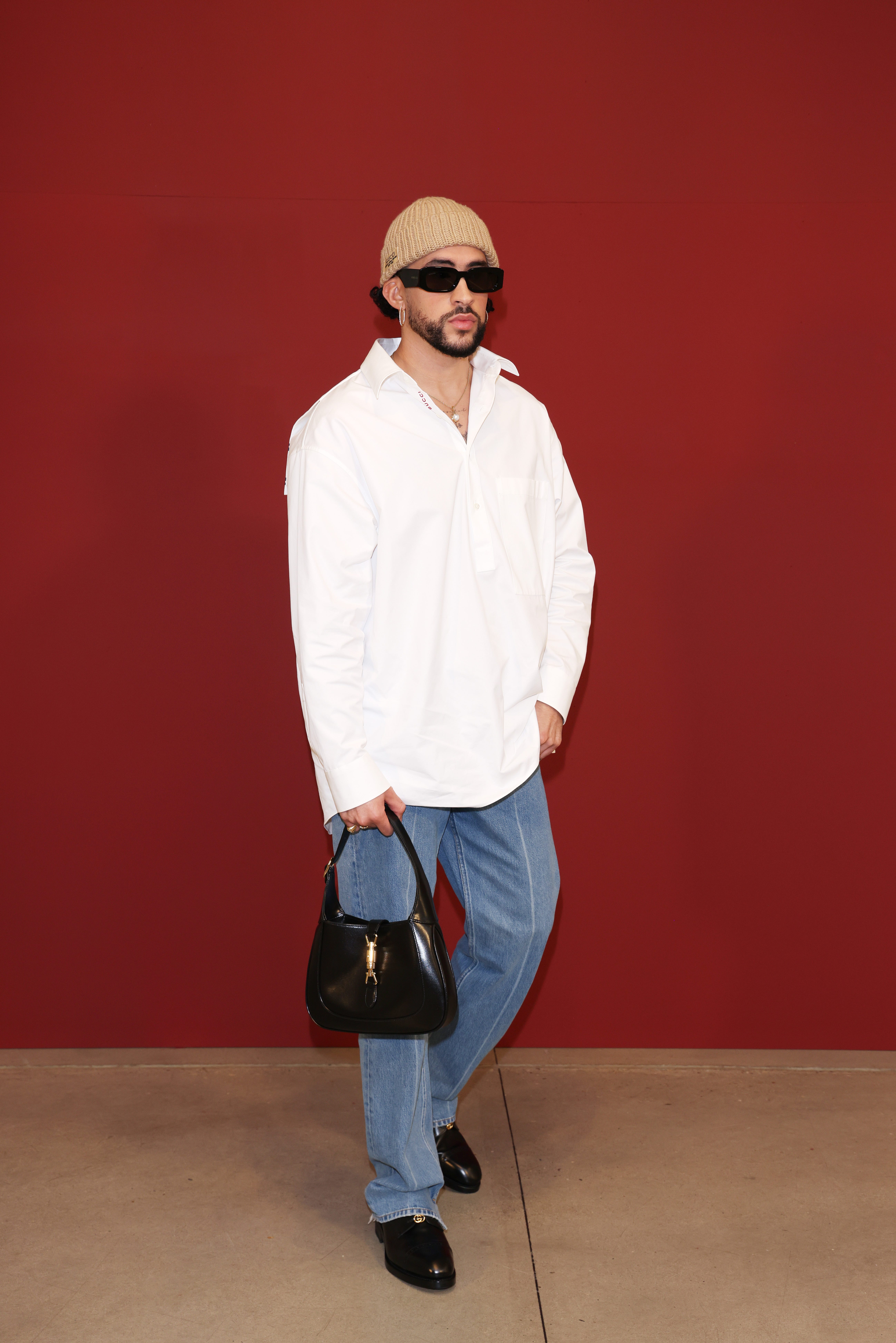


 Cardi B, Chencho Corleone, Ivy Queen and reggaeton duo Jowell y Randy." style="max-width:100%; height:auto; border-radius:6px; margin:10px 0;" loading="lazy" />


 declaring Oct. 1 as the official Bad Bunny Day." style="max-width:100%; height:auto; border-radius:6px; margin:10px 0;" loading="lazy" />




 two new wax figures at Orlando and New York's Madame Tussauds on April 19, 2022. The figure at Madame Tussauds New York is wearing the iconic all-silver look from the Grammy-winner's 2020 Super Bowl performance alongside Jennifer Lopez, Shakira, and J Balvin, complete with the same silver jacket he wore. The wax figure in Orlando is wearing an outfit originally from his WWE Royal Rumble performance and is featured in his "Booker T" music video. For the figure, Bad Bunny donated his trenchcoat, vest, trousers, and pants." style="max-width:100%; height:auto; border-radius:6px; margin:10px 0;" loading="lazy" />
  Bad Bunny is set to portray the title role in "El Muerto," making history as Marvel's first Latino lead in a live-action film. He calls the film the "perfect role" for him.
Before suiting up as the super-powered wrestler, the Puerto Rican rapper will make his big-screen acting debut in the neon-drenched "Bullet Train" (in theaters July 29), doing battle with Brad Pitt." style="max-width:100%; height:auto; border-radius:6px; margin:10px 0;" loading="lazy" />
 April 2021 at WWE's WrestleMania 37. In this photo, taken Jan. 29, 2022, Bad Bunny jumped into the ring again during the Royal Rumble match at The Dome at America's Center." style="max-width:100%; height:auto; border-radius:6px; margin:10px 0;" loading="lazy" />


 22nd Latin Grammy Awards. That night he took home the award for best rap/hip hop song for "Booker T" and best urban music album for "El Último Tour del Mundo."" style="max-width:100%; height:auto; border-radius:6px; margin:10px 0;" loading="lazy" />


Bad Bunny makes history at the Grammys. The Puerto Rican star's career in photos.
Bad Bunny accepts the album of the year award for "DeBÍ TiRAR MáS FOToS" onstage during the 68th Grammy Awards on Feb. 1, 2026, in Los Angeles
Bad Bunny, whose name isBenito Antonio Martínez Ocasio, has hinted his performance will be about unity during the trailer for the halftime show, where he danced with people from various ages and from diverse backgrounds, cultures and ethnicities.
But it will also, undoubtedly, be about Puerto Rico.
"Benito speaks first and foremost to Puerto Ricans, and so he doesn't really care what other people think, and I think that's part of the formula for his success," said Jorell Meléndez-Badillo, associate professor of Latin American and Caribbean History at the University of Wisconsin-Madison.
Bad Bunny leans into Puerto Rican pride
Over the past decade, Bad Bunny has skyrocketed to one of the world's biggest superstars, going from a local supermarket bagboy-turned-SoundCloud-rapper to themost streamed artist across the globe.
Through it all, he's leaned into his Puerto Ricanness.
Boricua slang like perreo (a type of dance linked to reggaeton music), janguear (to hang out) and bichiyal (a stylish woman) are sprinkled throughout many of Bad Bunny's songs. He's worn a pava, a traditional Puerto Rican straw hat, on red carpets and in the promo for the Super Bowl.

He highlighted the struggles Puerto Ricans experienced on the island following the devastating back-to-back hurricanes, including Hurricane Maria, in 2017, during adocumentary-style music videofor his hit, "El Apagon." He's highlighted the ongoing gentrification in Puerto Rico, including in his song "Lo Que Le Pasó a Hawaii" on his latest album.
"When you have a Puerto Rican, like Bad Bunny, appear on this massive platform, it is some sort of a reminder to viewers that Puerto Rico exists," Burgos-Matos said. "That Puerto Ricans are not just consumers of U.S. culture or passive participants of the U.S."
The rapper has also boostedtourism to the island. His residency last summer alone brought in estimates of$200 millionto more than$700 millionto Puerto Rico.
Bad Bunny shines a light on Puerto Rico's history
But Boricuas in the United States and on the island are hoping that viewers of the halftime show will do more than just Google tickets to visit the island. Instead, some are hoping it will shine a light on the island's deep history – and its complicated relationship with the United States.
Burgos-Matos, who left Puerto Rico more than a decade ago to further his education and now has a doctorate, currently lives in the Bronx, "an extension of Puerto Rico," he said. His journey is one that many in the diaspora take.
Roughly 5.8 million Puerto Ricans live in the United States, according toPew Research Center. Another 3.2 million live on the island, which is a U.S. territory, according tothe U.S. Census Bureau.
"There is a lot of trauma that Puerto Rico and Puerto Ricans have been enduring for the past years with, not only with the ongoing colonial status, but also the economic crisis, the mass migration, the unpayable debt," he said. "This…is a form of asserting some sort of cultural survival."

Mikey Cordero, an artist living in Santurce, Puerto Rico, a neighborhood in the island's capitol, said that Puerto Rico often "gets pushed to the side" politically and in media.
Specifically, Cordero hopes the performance will open a conversation about "colonization" and how laws in place, like the Jones Act, affect Puerto Rico's economy. Puerto Rico is an unincorporated U.S. territory, and has long been the subject of the debate on whether the island should become a state or an independent country.
"He's giving you breadcrumbs into the Puerto Rican experience," Cordero, 42, said. "I think if it brings more attention and more eyes on our story and our fight and our struggle – that's what I think even Bad Bunny wants – for you to like walk away with, to have that sense of prioritizing the Puerto Rican story."
'The more local Bad Bunny gets, the more universal he becomes'
Puerto Rico's story is a relatable one.
And some Boricuas anticipate that people from different ethnic and racial backgrounds won't feel excluded. Instead, they'll feel seen.

Meléndez-Badillo, who collaborated with Bad Bunny by writing historical narratives for videos for the artist's latest record, said the reggaeton superstar explores themes around displacement, gentrification, and longing for home.
"Those are things that people can connect with regardless if they're from Puerto Rico or not," he said. "Those are the things that people from the Global South have been dealing with for a long time."
Dámaris Otero-Torres, an associate professor at Rutgers Universitywho is teaching a class on the Puerto Rican star, said Bad Bunny's message in his music is universal and can create solidarity, even as he makes "sure that people understand the richness of Puerto Rico and all the things that it has to be, not only the U.S. and its community, but the world."
Him being chosen as an artist who sings and speaks almost entirely in Spanish is also a political act, Otero-Torres said, especially at a time in the United States where she says knowing another language is seen as a "liability."
"Why can't you open yourself to learn of the richness of the vastness of the culture? … The United States is an incredible melting pot," she said. "Speaking another language is not a liability. It enriches you. It allows you not only to understand other cultures, but to understand your own culture in deeper ways."
The more local Bad Bunny gets, the more universal he becomes, Otero-Torres, who is from the Río Piedras neighborhood in San Juan, recalled reading recently.
"I think that's true," she said.
This article originally appeared on USA TODAY:Bad Bunny's halftime show – What it means for Puerto Rico